
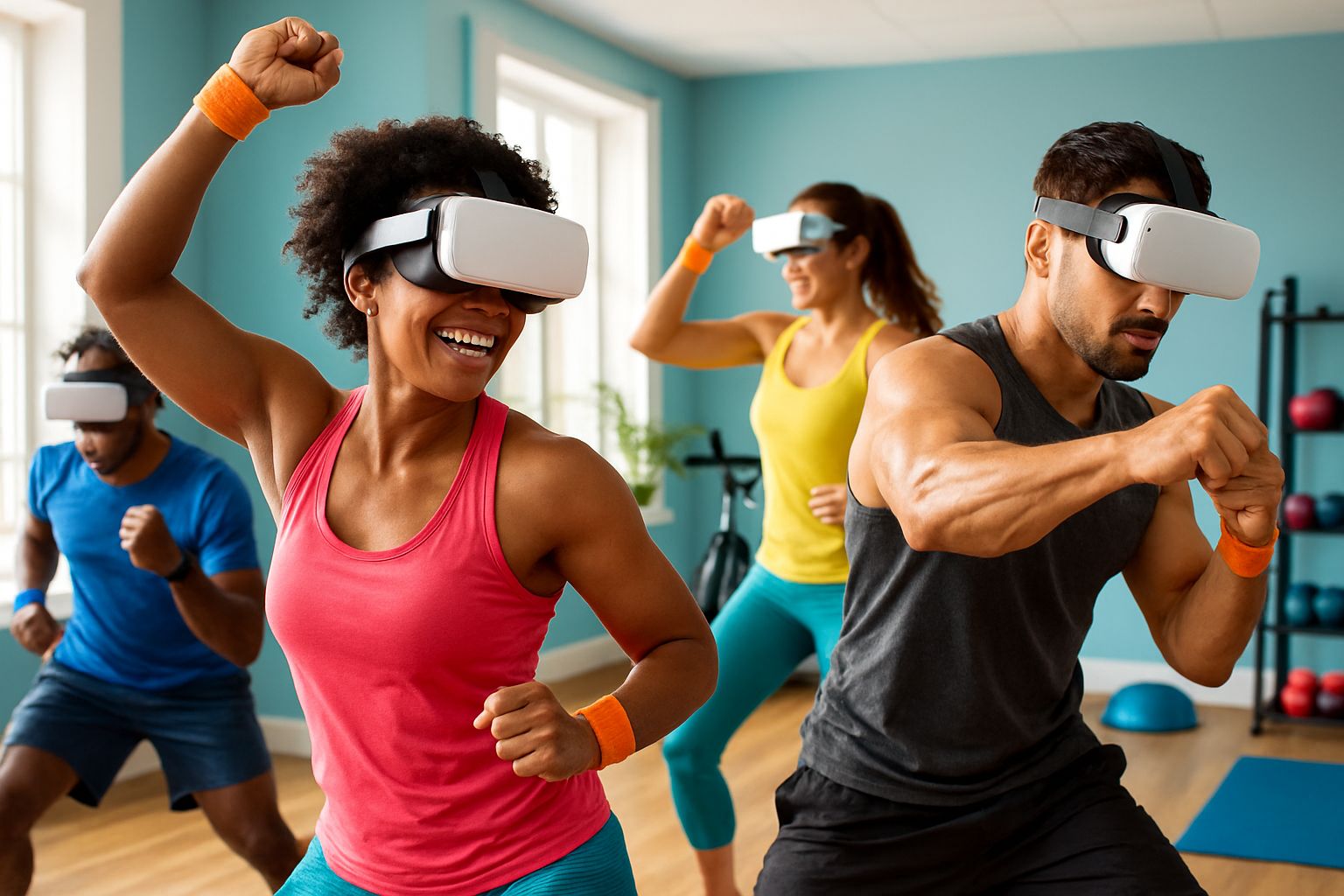
- FitXR leads the pack with seven distinct workout studios — including the newly added Zumba and mixed reality Slam mode — making it the most versatile VR fitness platform available right now.
- Supernatural delivers stunning coached workouts set to licensed music, but a cloudy content roadmap raises real questions about long-term value for subscribers.
- Les Mills XR BODYCOMBAT is the smartest one-time purchase in VR fitness, offering real martial-arts-inspired programming without a recurring subscription fee.
- FitXR’s newest updates include a mixed reality Slam mode and Zumba integration — two additions that significantly change how you can train at home.
- Not sure which app fits your goals? The head-to-head comparison later in this article breaks down coaching quality, content depth, and real value — so you can make the right call before spending a cent.
VR fitness has officially crossed the line from novelty to necessity — and the latest game releases prove it.
This month’s roundup covers the top VR fitness apps making real waves right now: FitXR, Supernatural, and Les Mills XR BODYCOMBAT. Whether you’re brand new to working out in a headset or you’ve been throwing virtual punches for years, knowing what’s new — and what’s actually worth your time — makes all the difference. FitXR has been at the center of this conversation, consistently updating its platform with new workout modes and fresh programming that keeps even seasoned users engaged.
The VR Fitness Scene Just Got More Exciting
The gap between traditional gym workouts and VR fitness is closing fast. Standalone headsets like the Meta Quest 3 have removed the biggest barrier — cables and complicated setup — and developers have responded by building programming that rivals what you’d find in a real studio. Calorie burns in a single FitXR boxing session can hit levels comparable to a moderate-intensity spin class, and the motivation to keep going when you’re immersed in a virtual environment is something treadmills simply can’t replicate.
What’s especially exciting about this month’s releases and updates is the range. You’ve got apps pushing deeper into mixed reality, others refining their coaching models, and one standout that’s giving subscription skeptics a compelling reason to finally commit to VR fitness. The competition is producing better products faster, and as a fitness enthusiast, that works entirely in your favor.
FitXR: Still the Gold Standard for VR Fitness Variety
FitXR didn’t get to the top of the VR fitness rankings by accident. It’s built around a simple but powerful idea: different people need different workouts on different days. The platform’s commitment to variety — real, structured variety, not just reskinned versions of the same movement pattern — is what separates it from every other app in this space. For more insights, check out this list of best VR fitness games.
What’s New in FitXR This Month
The most talked-about additions to FitXR recently are Zumba and Slam. Zumba brings licensed dance fitness programming directly into VR for the first time on this platform, giving users rhythm-based cardio that’s genuinely fun rather than just functional. Slam is something different entirely — a mixed reality mode that blends your physical environment with virtual targets, creating a workout experience that feels more grounded and spatially dynamic than anything in the standard VR library.
These aren’t minor patches. They represent a meaningful expansion of what FitXR can do and who it can serve. A user who was previously committed to boxing sessions now has seven distinct training environments to rotate through, each with its own movement demands and energy profile.
- Box — High-intensity punching combos with real defensive movement cues
- Dance — Rhythm-based cardio following choreographed routines
- HIIT — Interval training with full-body movement sequences
- Sculpt — Strength-focused sessions targeting specific muscle groups
- Combat — Mixed martial arts-inspired striking and footwork
- Zumba — Licensed Latin-inspired dance fitness, newly integrated
- Slam — Mixed reality mode using your physical space as part of the workout
Each studio within FitXR uses real coaches, not just animated avatars barking generic cues. The coaching is programmed to match intensity levels across beginner, intermediate, and advanced tracks — meaning the platform scales with you as your fitness improves.
The Seven Studios Breakdown: Which One Is Right for You
If you’re coming from a cardio background, Box and Combat will feel immediately familiar in terms of heart rate demand. Dance and Zumba are lower-impact but surprisingly effective for sustained calorie burn because the sessions run longer and keep your feet moving continuously. HIIT and Sculpt are where FitXR gets serious about strength and conditioning — these modes push beyond pure cardio into territory that gym-goers will recognize and respect. Slam, as the newest addition, is best suited for users with a bit of open floor space and a Meta Quest 3 or newer headset to get the full mixed reality benefit.
How FitXR’s Slam Mode Changes the Game
Slam is worth calling out separately because it represents a genuine shift in how VR fitness interacts with your real environment. Instead of being fully immersed in a virtual world, Slam overlays workout targets onto your physical space — your actual room becomes the playing field. This means your body is responding to real spatial cues rather than purely virtual ones, which engages your proprioception and coordination in a way that standard VR workouts don’t always reach.
For users who’ve felt slightly disconnected from traditional VR workouts — particularly those who find full immersion disorienting — Slam offers a compelling middle ground. It’s one of the more innovative fitness features to come out of any VR platform this year, and it positions FitXR well ahead of competitors who are still operating entirely within closed virtual environments.
Supernatural: Beautiful Workouts With a Cloudy Future
Supernatural has one of the most visually stunning workout experiences in VR. Sessions take place in breathtaking real-world locations — from Icelandic glaciers to Saharan dunes — and the licensed music library pulls from major artists in a way that genuinely elevates each workout. It’s the kind of app that makes you forget you’re exercising, which for a lot of people is exactly the point.
What Makes Supernatural’s Coaching Stand Out
The coaches in Supernatural are warm, present, and highly motivating — more personal trainer than drill sergeant. Each Flow session guides you through wide sweeping arm movements synchronized to music, while Boxing workouts focus on striking targets to the beat. The combination of elite coaching, iconic music, and world-class visuals creates an emotional engagement with fitness that’s hard to find anywhere else, in VR or out of it.
The Content Roadmap Concern Every Subscriber Should Know
Here’s where things get complicated. Supernatural’s long-term content roadmap has raised concerns in the VR fitness community, and those concerns are legitimate. The app operates on a subscription model, which only makes sense as long as fresh, high-quality content keeps arriving. If programming slows down or the platform pivots — both of which have been discussed publicly — subscribers paying a monthly fee could find themselves locked into a platform that’s no longer evolving. Before committing to Supernatural, it’s worth acknowledging that uncertainty exists and factoring it into your decision.
Les Mills XR BODYCOMBAT: The Best One-Time Purchase in VR Fitness
Les Mills XR BODYCOMBAT takes everything that made the original Les Mills BODYCOMBAT program a global fitness phenomenon and translates it into VR with remarkable accuracy. The martial-arts-inspired striking sequences, the high-energy music tracks, and the structured programming blocks all carry over in a way that feels genuinely faithful to the original — not like a watered-down version built to fill an app store shelf.
What makes it the standout non-subscription option is straightforward: you pay once, you own the content. For users who bristle at recurring fees — especially in a market where subscription fatigue is real — Les Mills XR BODYCOMBAT offers a complete, polished fitness product without the ongoing financial commitment. The tradeoff is that you won’t get the constant stream of new classes that subscription apps deliver, but what’s there is deep enough to keep most users busy for months.
What the October Update Actually Added
Les Mills XR BODYCOMBAT’s most recent update sharpened the tracking precision on striking targets, making the feedback loop between your punch and the virtual impact feel noticeably tighter. The update also introduced additional difficulty tiers within existing workout tracks, so users who’ve been running the same sequences for weeks can now increase the challenge without waiting for entirely new content to drop. For more information on the best VR fitness apps, check out this guide on top VR fitness games.
The Mixed Reality Mode: How It Works and Who It’s For
Les Mills XR BODYCOMBAT’s mixed reality option uses your headset’s passthrough cameras to blend virtual targets into your real environment. Rather than being transported to a fully virtual dojo, you’re standing in your living room throwing combinations at digital targets overlaid on your actual walls and floor space. It creates a grounded, spatially accurate experience that works especially well for users who struggle with motion sickness in fully immersive VR environments.
This mode is particularly well-suited to people who are newer to VR fitness or who train in smaller spaces. Because you can see your real surroundings, you’re less likely to misjudge distance or accidentally connect with your furniture mid-roundhouse. It’s a practical design choice that makes the app more accessible without dumbing down the actual workout programming.
Why the Missing Cool-Down Is a Real Problem
One consistent criticism of Les Mills XR BODYCOMBAT is the absence of a structured cool-down sequence built into every session. In a traditional gym class, the cool-down is non-negotiable — it manages heart rate recovery, reduces post-workout soreness, and signals to your nervous system that the hard work is done. Without it baked into the VR experience, users either need to build their own cool-down routine outside the headset or skip it entirely, which over time can contribute to tightness and elevated recovery time.
This isn’t a dealbreaker, but it’s a real gap in an otherwise well-designed product. If you’re committing to Les Mills XR BODYCOMBAT as a primary training tool, build five minutes of stretching and breathing into your post-session routine outside the headset. Your body will thank you after the third consecutive training day.
Head-to-Head: FitXR vs Supernatural vs Les Mills XR BODYCOMBAT
Choosing between these three comes down to understanding what actually drives your consistency. The best workout app isn’t the one with the highest ratings — it’s the one you’ll open every day. And the factors that keep you coming back are deeply personal: some people need variety, others need emotional connection through music, and others just need a solid program they can trust without paying monthly.
All three platforms deliver real, measurable fitness results when used consistently. The differences lie in how they motivate you to stay consistent, how much content depth they offer over time, and what they cost you to access that content. Here’s how they stack up across the metrics that matter most.
| Feature | FitXR | Supernatural | Les Mills XR BODYCOMBAT |
|---|---|---|---|
| Workout Variety | 7 studios including Zumba & Slam | Flow and Boxing only | BODYCOMBAT-focused with difficulty tiers |
| Coaching Quality | Real coaches, intensity-scaled | Premium, highly personal | Structured, program-led |
| Music | Curated fitness tracks | Major licensed artists | High-energy program music |
| Mixed Reality | Yes (Slam mode) | No | Yes (passthrough mode) |
| Pricing Model | Subscription | Subscription | One-time purchase |
| Content Roadmap | Actively expanding | Uncertain | Periodic updates |
Workout Variety and Content Depth
FitXR wins this category without much contest. Seven distinct studios, each with its own movement vocabulary, coaching style, and intensity range, means you can train five days a week for months without repeating the same session twice. The addition of Zumba and Slam this year pushed the platform’s content depth into territory that Supernatural and Les Mills XR BODYCOMBAT simply don’t match.
Supernatural’s content depth is solid within its two formats — Flow and Boxing — but the ceiling is lower. If you love those two modalities, you’ll find plenty to work with. If you need more, you’ll hit the edges of the library faster than you expect. Les Mills XR BODYCOMBAT sits in between: its programming is deep within the BODYCOMBAT format, but it’s still one discipline compared to FitXR’s seven.
Coaching Quality and Programming
Supernatural edges out the competition specifically on the emotional quality of its coaching. The coaches feel present, encouraging, and genuinely invested in your session — it’s the closest thing to having a personal trainer in the headset with you. FitXR’s coaching is excellent and technically precise, scaling properly across skill levels, while Les Mills XR BODYCOMBAT delivers structured, no-nonsense programming that mirrors what you’d get in a real Les Mills class. All three are strong; the right choice depends on whether you want warmth, technical precision, or structured programming.
Motivation Features and Consistency Tools
FitXR leads on social motivation with multiplayer sessions, leaderboards, and group class features that make training feel communal even when you’re working out alone in your living room. These features matter more than most people realize — research consistently shows that social accountability is one of the most reliable predictors of long-term exercise consistency.
Supernatural uses visual immersion and music as its primary motivation engine, which works brilliantly for users who are moved by environment and sound. Les Mills XR BODYCOMBAT leans on the inherent structure of its programming — knowing that each session is part of a deliberate system keeps goal-oriented users coming back. Pick the motivation style that matches how you’re actually wired, not how you think you should be motivated.
Value for Money: Subscription vs One-Time Cost
Les Mills XR BODYCOMBAT is the clear winner on pure value math if you plan to train consistently for more than six months. A one-time purchase that delivers a complete, professionally programmed fitness product beats a recurring monthly fee — especially when that fee compounds over a year or more. The caveat is that you’re trading ongoing fresh content for upfront ownership.
FitXR’s subscription makes financial sense when you factor in the sheer volume of content and the pace of new releases. If you’re using the platform four to five times a week across multiple studios, the cost-per-session math works in your favor quickly. Supernatural’s subscription is the hardest to justify given the content roadmap uncertainty — you’re paying premium subscription pricing for a platform whose future programming commitments aren’t fully guaranteed.
How to Pick the Right VR Fitness App This Month
The honest answer is that no single app is right for every person. What matters is matching the platform’s strengths to your specific training psychology — because even the best-designed fitness app in the world does nothing if you don’t open it. Think about what has made you quit exercise routines in the past and choose the app that directly addresses that weakness.
If boredom has been your fitness kryptonite, you need variety on demand. If motivation is the issue, you need emotional engagement through music or community. If cost anxiety makes you second-guess every subscription, you need a one-time purchase you can trust. Each of these three platforms is built to solve a different version of the same problem.
Pick FitXR If You Get Bored Easily
FitXR is purpose-built for variety seekers. The ability to jump between boxing, dance, HIIT, Zumba, and mixed reality Slam within a single week — or even a single day — means you’re never locked into the same movement pattern long enough for boredom to set in. The platform’s consistent release cadence for new classes and modes means the library you have access to today will be meaningfully larger in three months.
It’s also worth noting that FitXR’s scalability makes it a long-term platform rather than a novelty you outgrow. The beginner tracks and advanced tracks within each studio are genuinely different in intensity and complexity — this isn’t just a difficulty slider, it’s a real progression system that rewards consistent training with appropriate challenge over time.
Pick Supernatural If Music and Scenery Drive You
If your workout motivation lives and dies by the playlist, Supernatural is genuinely hard to beat. The platform’s licensed music library pulls from recognizable mainstream artists in a way that creates a real emotional connection to each session — you’re not just exercising to generic fitness beats, you’re moving through stunning virtual landscapes to songs you actually know and love. That combination of iconic music and world-class visual environments creates an immersive pull that keeps certain users coming back with a consistency that more technically structured apps can’t match.
The important caveat remains the content roadmap uncertainty. If you do commit to Supernatural, go in with eyes open — enjoy what the platform does brilliantly right now, but don’t build your entire fitness identity around it until there’s more clarity on where the programming is heading long-term. It’s a spectacular experience; just not a guaranteed one.
Pick Les Mills XR BODYCOMBAT If You Hate Subscriptions
If the idea of another monthly fee makes you close the app store immediately, Les Mills XR BODYCOMBAT removes that friction entirely. You buy it once, you own a professionally built martial-arts-inspired fitness program that can deliver real cardiovascular and strength results for months. The missing cool-down is a genuine gap to plan around, but for subscription-averse users who want structured, high-quality VR fitness programming, there is no better one-time purchase available right now.
FitXR Is the Safest Bet for Most VR Fitness Enthusiasts Right Now
When you weigh variety, coaching quality, content roadmap confidence, mixed reality innovation, and long-term scalability together, FitXR comes out on top for the majority of VR fitness users. Seven studios, a genuinely expanding library, social motivation tools, and two significant new modes in Zumba and Slam make it the platform most likely to still be earning its subscription fee six months from now. For anyone who takes their fitness seriously and wants a VR platform that grows with them, FitXR is the clearest recommendation in this month’s roundup.
Frequently Asked Questions
Here are the most common questions fitness enthusiasts ask before committing to a VR fitness platform — answered directly so you can make a confident decision.
How Many Calories Can You Burn With FitXR in a Single Session?
Calorie burn in FitXR varies significantly depending on the studio, session length, your body weight, and how hard you push. High-intensity modes like Box, Combat, and HIIT consistently produce the highest burn rates, with vigorous sessions capable of reaching outputs comparable to moderate-intensity traditional cardio workouts.
The most reliable way to track your actual burn is to pair your VR session with a heart rate monitor — a chest strap or compatible wrist-based device worn during training. Heart rate data gives you a far more accurate calorie picture than any in-app estimate, and it also helps you gauge whether you’re training in the right intensity zone for your specific fitness goals.
Is Supernatural Worth the Subscription Given Its Uncertain Future?
Right now, Supernatural still delivers one of the most emotionally compelling workout experiences in VR — if music, scenery, and warm coaching are what drive your consistency, the current product justifies the cost. The concern isn’t about what Supernatural is today; it’s about what the platform commits to being twelve months from now.
The safest approach is to start with a monthly subscription rather than committing to an annual plan until there is more public clarity on the content roadmap. That way you get full access to everything Supernatural offers right now while retaining the flexibility to pivot if the programming slows down or the platform changes direction.
Does Les Mills XR BODYCOMBAT Work on All VR Headsets?
Les Mills XR BODYCOMBAT is primarily designed for Meta Quest headsets, including the Quest 2 and Quest 3. The mixed reality passthrough feature requires a headset with color passthrough capability, which means Quest 3 users get the fullest experience — Quest 2 users can still access the full workout library, but the mixed reality mode is limited by the older headset’s monochrome passthrough cameras. Always check the Meta App Lab or Meta Store listing for the most current headset compatibility details before purchasing.
How Often Does FitXR Release New Workouts and Classes?
FitXR operates on a consistent content release schedule, adding new classes across its studio lineup regularly. The platform’s subscription model is built around ongoing content delivery — new boxing combos, dance routines, HIIT sequences, and sculpt sessions are added frequently enough that active users rarely exhaust the fresh content between updates. The addition of entirely new studios like Zumba and Slam demonstrates that FitXR’s updates extend beyond individual classes into whole new training formats, which is a meaningful indicator of the platform’s long-term development commitment.
Can You Use VR Fitness Apps as Your Only Form of Exercise?
For cardiovascular fitness, yes — VR fitness apps like FitXR can absolutely serve as a primary cardio training tool, delivering heart rate elevation, sustained aerobic effort, and calorie burn that matches or exceeds many traditional cardio modalities. The variety across FitXR’s seven studios means you can hit different movement patterns and energy systems throughout the week without leaving the headset.
Where VR fitness still has limitations is in progressive overload for strength training. FitXR’s Sculpt mode and similar strength-focused VR workouts engage muscles meaningfully, but they can’t replicate the resistance progression you get from adding weight to a barbell or adjusting a cable machine. For users focused primarily on fat loss, cardiovascular health, and functional fitness, VR can be the centerpiece of their routine. For those with specific hypertrophy or maximal strength goals, VR works best as a powerful complement to resistance training rather than a complete replacement.
The bottom line: VR fitness is no longer a novelty supplement to real training — for the right goals, it is the real training. FitXR’s breadth of programming makes it the strongest platform to build that primary training routine around, and its continued investment in new modes and studios means the platform will keep pace with your fitness journey as it evolves.
0 responses to “VR Fitness Game Highlight: Monthly Roundup of Top Releases Including FitXR”